Why it is useful
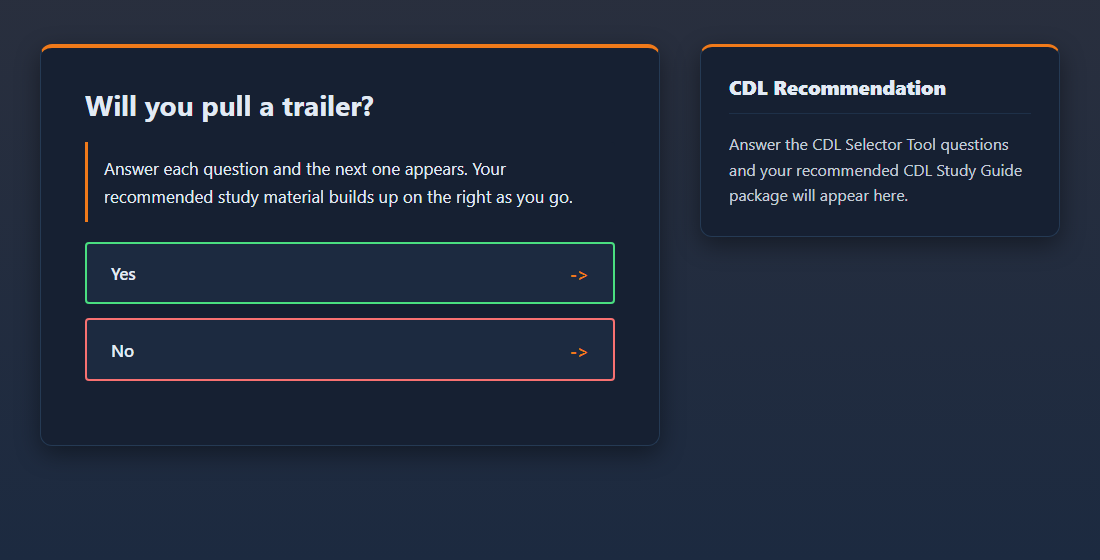
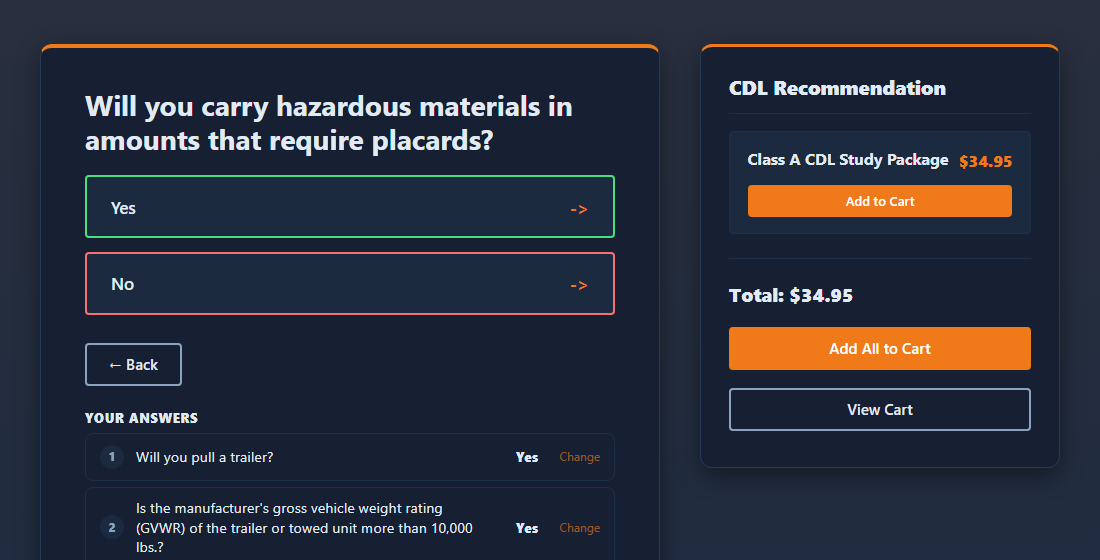
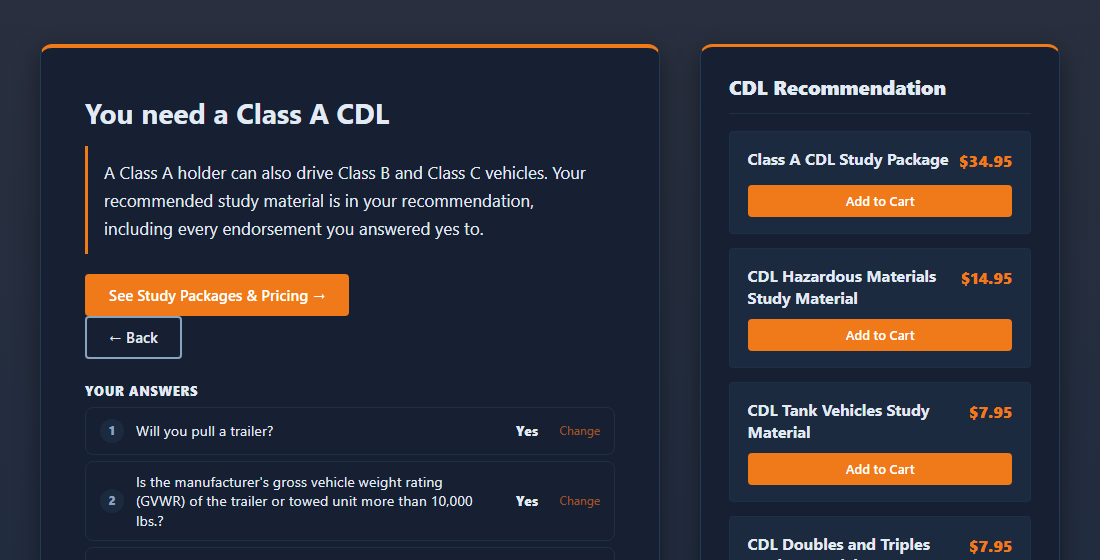
Most people searching "what CDL do I need" get buried in weight tables and legal definitions. The Selector turns the rules into plain questions: Will you pull a trailer? Is the GVWR over 26,000 pounds? Will you carry passengers or hazardous materials? Each answer narrows it down, and you finish with a clear result instead of a guess. It also stops you from studying the wrong material: a driver who only needs a Class B does not need to pay for Combination Vehicles, and a HazMat driver will not forget that the Tank endorsement usually goes with it.
Why you can trust it
The questions follow the federal CDL classifications in 49 CFR 383.91, the same definitions every state licensing agency uses: a Class A for combinations with a GCWR of 26,001 pounds or more towing a unit over 10,000 pounds, a Class B for single vehicles rated 26,001 pounds or more, and a Class C for lighter vehicles that carry 16 or more passengers or placarded hazardous materials. Endorsement questions use the FMCSA definitions for tank vehicles, HazMat, passenger, school bus, and doubles and triples. Every answer path has been checked so it ends at a correct result. It is a starting point, not legal advice, so confirm details with Arkansas Department of Finance and Administration before you test.
Who it helps
- New drivers deciding between a Class A and Class B CDL before spending money on training.
- Career changers looking at trucking, bus driving, or local delivery who want to know what license the job requires.
- Small business owners and farmers who pull heavy trailers and need to know if a CDL applies to them.
- School bus and transit drivers who need the Passenger and School Bus endorsements and want the right study material in one step.
- Current CDL holders adding a HazMat, Tank, or Doubles and Triples endorsement, or upgrading from Class B to Class A.
Already know the vehicle?
If you can name the truck you want to drive, you can skip the questions. Each guide gives the class, the weight limits that decide it, the knowledge tests you take and what people get wrong.
See every vehicle and the CDL it needs →
Arkansas hosts major national retail and food distribution networks with dense interstate freight traffic.
Where Arkansas CDL drivers work
- Retail distribution
- Poultry and food processing
- Steel and metals
- Trucking and logistics
Key routes: I-30, I-40, I-55
Federal rules that apply in Arkansas and every other state
- Minimum age: 18 to drive within the state; 21 to cross state lines, carry placarded hazardous materials, or drive for hire across state lines (49 CFR 391.11).
- Learner's permit first: you must hold a commercial learner's permit (CLP) for at least 14 days before taking the skills test, and pass the General Knowledge test to get it.
- Entry-level driver training (ELDT): first-time Class A or B applicants, Class B to A upgrades, and first-time H, P, or S endorsements must complete training from a provider on the FMCSA Training Provider Registry before the skills or knowledge test.
- Medical certificate: a DOT medical examiner's certificate is required, and you must self-certify your type of driving with the state.
- HazMat endorsement: requires a TSA security threat assessment (fingerprints and background check) in addition to the knowledge test; it has to be renewed with the endorsement.
- Air brake restriction: skip the air brakes test, or take the skills test in a vehicle without air brakes, and your CDL carries an L or Z restriction.
Fees, appointment systems, testing locations, and processing times are set by Arkansas Department of Finance and Administration and change over time, so confirm them on the agency site before you book a test.